|
Trophy Hunting in Namibia
Hunting has existed here already for the last few centuries as one can see from the rock paintings in Namibia. Then, in 1962, a couple of farmers started with a project to effectively utilize our natural recourses over the years and become an important factor of the Namibian economy. Today, trophy hunting is an effective form of land utilization.
 In 1974, the Namibia Professional Hunting Association (NAPHA) was founded. Today, the Association has more than 400 members. Namibia offers literally an unlimited range of hunting possibilities, with accommodation ranging from adventurous tent camps to inviting hunting, guest and game farms, and comfortable safari camps in the national concession areas. In 1974, the Namibia Professional Hunting Association (NAPHA) was founded. Today, the Association has more than 400 members. Namibia offers literally an unlimited range of hunting possibilities, with accommodation ranging from adventurous tent camps to inviting hunting, guest and game farms, and comfortable safari camps in the national concession areas.
30 years of trophy hunting in Namibia, and the experience of other countries in southern Africa in this regard, have revealed that the principle of sustainable utilization is vital for the maintenance of a biological balance, and that this principle should be applied to game, too. It is the only way to manage practical nature conservation efficiently and it is of such importance that it has been entrenched in the Constitution of our young Democracy.
Some European and American conservationist groups are under the impression that a ban on hunting would be the 'last hope' for the animal kingdom. But we here in Africa, hunters and conservationists, are convinced that hunting, in particular, is a major contributor in ensuring the continued existence of our game populations. Our longstanding experience and the findings of scientific research projects support our opinion. Africa's population will only be interested in a long-term utilization of our game and in ensuring its continued existence, if it is to the population's economic benefit. Should the game have no economic value for the local population, cattle, sheep, and goats will drive it out of its natural habitat.
For you, dear hunter, this entails that not only a unique hunting experience is waiting for you in Namibia. You will make a major contribution to the conservation and stabilization of our rich fauna through visiting our country.
 But conserving and stabilizing the basis of life for our game is only one of our goals. It is a known fact that poverty and population growth are the biggest threats to nature in Africa. Desertification, over-grazing, deforestation, bush encroachment, and pollution are only some of the severe consequences arising. But conserving and stabilizing the basis of life for our game is only one of our goals. It is a known fact that poverty and population growth are the biggest threats to nature in Africa. Desertification, over-grazing, deforestation, bush encroachment, and pollution are only some of the severe consequences arising.
The kind of nature conservation which is only oriented toward the preservation of species and solely aesthetically motivated does not satisfy the needs of our actual situation, in view of socioeconomic realities. It is rather appropriate to include the entire biophysical environment, in other words, the economic scope of game and other natural resources have to be developed in such a way that they will contribute directly to raise the living-standard of the local African population. Emphasis has to be placed on the sustainable utilization of regenerative resources in order to create employment, accommodation, education and training facilities for the local population. Rural development should be promoted without destroying the environment.
Not only we and you, dear hunter, should have the privilege to enjoy hunting. We should also try to keep it that way for the generations to come. This is why we consider it important to maintain the high standards of our hunting ethics. If hunting ethics are practised in an immaculate manner, anti-hunting groups will soon lose their argument. The success of a hunt should be assessed on the quality of the trophies and on the manner in which it is conducted. Hunting ethics can only be improved with the individual's input.
I invite you to be a conscientious hunter in Namibia who respects the following four essential factors of Namibian hunting ethics:
- The principle of sustainable utilization of our game.
- Hunting in our magnificent nature has to be practised according to fair principles.
- The hunter is entitled to enjoy his hunt.
- Hunting in our country should always be to the advantage of our local population and environment.
 Considering and understanding these factors, which are of such vital importance to us, will make your hunting vacation in Namibia a true experience. Understanding forms a bridge between people. Many have crossed this bridge to our shores and it is probably the reason why so many people who have caught the famous "Africa-virus" keep on coming back to our beautiful country. Considering and understanding these factors, which are of such vital importance to us, will make your hunting vacation in Namibia a true experience. Understanding forms a bridge between people. Many have crossed this bridge to our shores and it is probably the reason why so many people who have caught the famous "Africa-virus" keep on coming back to our beautiful country.
The hospitality of our people is waiting for you, whether you come to our country as an old friend or as a new guest. In Namibia, you can still hunt at reasonable rates on farms, hunting farms or in huge concession areas. We would like you to be well informed about hunting in Namibia when starting on your trip. We hope that you will enjoy our country and that all your hunting dreams will come true!
General Information on trophy hunting in Namibia:
Trophy hunting in Namibia has a relatively short history. Since the early sixties, foreign hunting guests have been coming to our country. Due to the strong commitment of German speaking Namibian farmers and hunters to make trophy hunting a success, the Namibian code of ethics and hunting practice is strongly influenced by German hunting regulations and the German code of ethics. Since its foundation, the Namibia Professional Hunting Association (NAPHA) has endeavoured, in close cooperation with the Ministry of Environment and Tourism, to set up clear-cut hunting rules and regulations in order to protect our wildlife and hunting ethics, to adapt these rules to a changing environment and to further develop and improve them. Increased research efforts on wildlife will enlarge our knowledge on individual game species. If one proceeds from the fact that not even five percent of all utilised game in Namibia is utilised through trophy hunting, and that farmers have an economic interest in protecting huntable game populations on their land, then one can assume that hunting has promising long-term prospects.
Agriculture and hunting areas
The central highlands, at an average altitude of 1500m, are mainly grassland used for extensive livestock breeding (cattle, karakul sheep, goats, horses). Farms measure at least 5000 ha and are subdivided into fenced-in camps, measuring 200 to 400 ha each. All pastures have open waters, referred to as dams, or drinking spots where subterranean water is pumped up by a windmill engine or solar energy. These drinking spots are also accessible to game and often the reason why game would be "faithful" to a particular area. Flowing waters are a rarity, they only occur for a few days during the "big" rainy season (from December to April) and sometimes even during the "small" rainy season (September to October). But normally, the river beds are dry. These river beds are referred to as riviere, the Afrikaans words for 'river', have high ground-water levels and are usually full of lush vegetation.
The central highlands are covered mainly by a savanna-type vegetation, in parts going over to dense bushveld. The south and western areas of the country are much more arid and therefore have little vegetation cover.
 Since Government and the private sector have an interest in making hunting tourism a success, a sensible and sustainable utilization of game populations will be the best way of protecting wildlife and its habitat. The range of hunting possibilities offered expands continuously. New areas are designated for hunting: today, guests can hunt in a unique landscape at the edge of the Namib Desert. In the north of the country, huge concession areas have been opened for big-game hunting in order to control overpopulation of elephant and lion. The Government encourages the development of hunting farms and private sanctuaries by translocating overpopulation of game species from national parks onto private land. Since Government and the private sector have an interest in making hunting tourism a success, a sensible and sustainable utilization of game populations will be the best way of protecting wildlife and its habitat. The range of hunting possibilities offered expands continuously. New areas are designated for hunting: today, guests can hunt in a unique landscape at the edge of the Namib Desert. In the north of the country, huge concession areas have been opened for big-game hunting in order to control overpopulation of elephant and lion. The Government encourages the development of hunting farms and private sanctuaries by translocating overpopulation of game species from national parks onto private land.
Specific breeding-programmes made it possible that a number of species formerly endemic to Namibia as well as other species could be successfully re-introduced in most areas of the country. This means that the hunter who has already in the past hunted successfully in Namibia will now find additional huntable species on many game farms, and he can hunt rewarding trophies in a familiar environment.
Trophy hunting regulations
Namibia’s current Hunting Ordinance is based on the hunting code drafted 25 years ago. After independence, most of the original regulations are still in force.
The Hunting Ordinance also determines the different accommodation categories for hunting guests. A differentiation is made between hunting and guest farms. Hunting farms are agricultural businesses which also undertake trophy hunting, either as a full-time or as a part-time venture. Hunting guests are accommodated and catered for on the farm. Minimum facilities are prescribed by the Ordinance, but all farms offer far more than the basic requirements.
Guest farms are accommodation establishments with or without hunting possibilities. They need to have a minimum of five guest rooms. Their facilities need to be of a higher standard than those of a hunting farm. Like all hunting safari operators, guest farms are also graded according to their facilities and services offered and awarded one, two or three stars. Services
Apart from accommodation, hunting safari operators, guest and hunting farms also offer services like transport, tracking, hunting guidance, and trophy preparation. Hunting farms may require payment for these services and for trophies, but also for other services, such as rifle-leasing, assistance with import declaration procedures for arms and ammunition or application for permits.
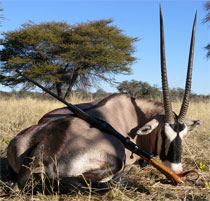 The rates for trophies and accommodation are at this point in time not prescribed by the authorities. However, the Namibia Professional Hunting Association (NAPHA) suggests to its members to adhere to the rates recommended by the Association, which are updated from time to time. The rates for trophies and accommodation are at this point in time not prescribed by the authorities. However, the Namibia Professional Hunting Association (NAPHA) suggests to its members to adhere to the rates recommended by the Association, which are updated from time to time.
The hunter has to make sure which price he will have to pay for each animal before the hunt. The meat of the trophy animal is the property of the landowner.
Under all circumstances, the trophy hunter will have to pay for animals which have been wounded and which cannot be found. But the rate for such animal may not be higher than the rate agreed upon before the hunt.
Hunting guidance is prescribed
In terms of the Nature Conservation Ordinance, each trophy hunter has to be accompanied by a registered professional hunter or hunting guide while out hunting. The regulations of the Nature Conservation Ordinance are binding on both, hunter and hunting guide. The authorities will act on any violation of the rules. It is, for example, prohibited to leave a trophy hunter by himself at a hide without a hunting guide staying with him. The excuse that such hunter only wanted to watch the game, to enjoy the sunset or the tranquillity will not be accepted, unless such person is found without a rifle.
The importance of permits
In terms of the Nature Conservation Ordinance, no one may go out hunting without having obtained the necessary permit (Namibia hunting permit) beforehand. Only those animals which are listed on the permit may be hunted.
Export permits will only be granted for trophies hunted according to the hunting permit, while hunting, the hunter has to have the permit on him and at the end of a hunting day, the columns at the back of the licence have to be completed and signed by him. The hunting guide's signature is required as well. At the end of the hunting vacation, the licence will have to be handed over to the hunting guide who has to submit it to the permit office for export clearance of the trophies.
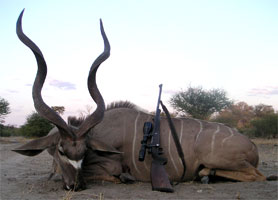 Arms and ammunition Arms and ammunition
Bow hunting is only possible with a proper licensed guide. Should a person be found carrying bow and arrow, then it will be assumed that such person intended to hunt with these instruments.
No solid bullets may be used on a hunt (this does not apply to elephant and buffalo). Only normal hunting ammunition is admissible. Only arms with the following disruptive charge may be used for the following animals:
- springbok and smaller animals: 1370 joule
- all other game, e.g., eland, kudu, gemsbok, wildebeest, and zebra: 2700 joule.
Important: No revolvers, pistols or automatic arms may be used for hunting, not even for a coup de grace. The importation of such firearms has been banned since 1991.
Definitions
The hunter has to understand the meaning of certain terminologies. In terms of the Nature Conservation Ordinance, "hunting" is defined as "the killing of game with all means; the attempt to kill game, to shoot it or the attempt to shoot it; pursuing, tracking, lying in wait for or driving the game with the intention to kill, shoot or disturb it intentionally".
A "trophy" is defined as the "hide or skin, armour, paws, hooves or claws, and heads or any part thereof, of game or wild animals". However, this definition will not apply to processed parts which have lost their original character.
"Venison" is defined as "the fresh, salted, smoked, dried meat of game or game meat which is being dried, including all bones in the meat as well as the whole body of a killed game species".
Game farms
Nature lovers will be aware of the fact that game populations are decreasing drastically in Africa. In a continent tormented by social and economic problems, nature conservation is an issue of minor importance.
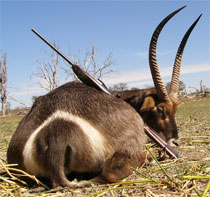 During the past years, environmental awareness in people has undergone a fundamental change. Many farmers have created game sanctuaries. Since traditional game areas are put under increased pressure by a fast growing population, sanctuaries are a realistic alternative to provide new areas for the game and to utilise land. During the past years, environmental awareness in people has undergone a fundamental change. Many farmers have created game sanctuaries. Since traditional game areas are put under increased pressure by a fast growing population, sanctuaries are a realistic alternative to provide new areas for the game and to utilise land.
African game farms cannot be compared with hunting areas in other areas of the world, as dimensions are entirely different. In Namibia, controlled trophy hunting may only be carried out in areas larger than 10 km². Most European hunting reserves are much smaller in size. Hunting areas measuring 100 km² are no rarity in our country.
In order to protect game populations more effectively from drought, epidemics, and poachers, game species which only occur in certain regions or national parks are translocated to new areas. Populations of rare species, such as roan and sable antelopes, black-faced impala, tsesseby and rhino, are increasing in numbers because they are kept and protected on private land. South African blesbok, waterbuck and black wildebeest have been translocated successfully to Namibia.
If the game finds its natural habitat on such farms and if it is hunted according to fair principles, then the positive aspects of a game fence will outweigh its negative impact. Trophy hunting only affects five percent of the game population and hunting promotes the growth of game populations by eliminating old trophy animals.
If you hunt on a farm where hunting is practised according to fair principles, you will contribute to the maintenance and growth of our game populations.
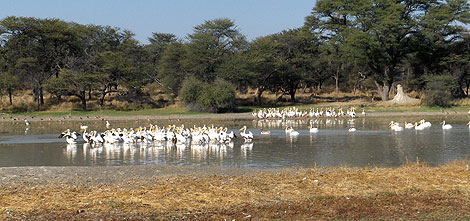
Trophy evaluation and quality control
After thorough consideration and on the Association's recommendation, a state-controlled measurement-formula, based on a centimetre scale, was introduced in March 1983. This formula enables identical quality control to be carried out and it facilitates the compilation of annual statistics. It has to be stated, however, that this formula is by no means in competition with international formulas because it is used within the borders of Namibia only. For the sake of simplicity, the Namibia-formula has been closely adapted to the S.C.I. (Safari Club International, USA)-formula.
In the event of spiral horns (kudu and eland) each horn is measured with its curve and the lengths of both horns are added. The circumference of both bases is added thereto and the total obtained corresponds to the centimetre points.
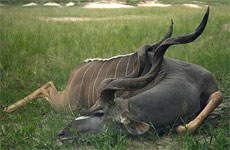 The horns of all other Namibian antelopes (oryx, springbok, hartebeest, duiker, and steenbok) are measured from the centre of the base towards the tip. The length of both horns added to the circumference of both bases gives the total centimetre The base of the horn is measured at its widest spot. When measuring the length, ridges in the horn will not be included in the measurement. The horns of all other Namibian antelopes (oryx, springbok, hartebeest, duiker, and steenbok) are measured from the centre of the base towards the tip. The length of both horns added to the circumference of both bases gives the total centimetre The base of the horn is measured at its widest spot. When measuring the length, ridges in the horn will not be included in the measurement.
When measuring the tusks of warthogs, only circumference and length of the largest tusk are evaluated. Every hunting guide or professional hunter has a check-list of how to measure horns or tusks of other animals.
Trophy control has been implemented in order to avoid that hunting guests are offered inferior trophies, in other words, trophies of too young animals. Failing below the minimum length prescribed by the authorities will only be accepted for over-aged animals. The measuring system is there to protect the rights of the hunting guest. The hunting guest can, for instance, refuse to pay for too small (young) trophies. Should hunting guides or professional hunters deliberately enter wrong measurements on the hunting permit, legal steps will be taken which may entail the withdrawal of their licence. The minimum points for trophies (which might even be raised after an initial trial period) are published on an official list, available to the hunting guest. Apart from the Namibian system of quality control where measuring may take place immediately after hunting, similar to the S.C.I. system, hunting guests can have their trophies measured and registered officially by, e.g., Rowland Ward, after the essential drying period.
Medals for Namibian hunting trophies
Inspired by the comments of many interested guest hunters, and after having considered the subject thoroughly for some time, the idea to reward mature, royal trophies in an appropriate manner materialised more and more. Any shooting of abnormal and over-aged animals also has to be carried out according to ethical and protective principles.
Medals must have international significance and credit in order to be meaningful, respectable and desirable. Therefore, the Namibian medal system has been based on the requirements of the internationally known and recognized organization S.C.I. (Safari Club International), except for oryx and warthogs.
Trophies reaching the measurement points of record trophies registered in the SCI-book would be awarded a silver medal.
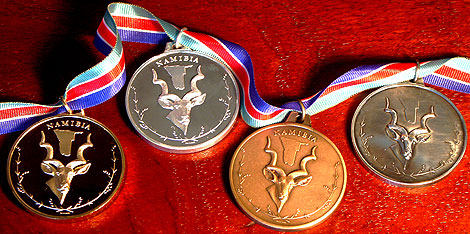
Trophies ranging five percent below the SCI-value would be awarded a bronze medal. Trophies ranging five percent or more above the SCI-value quality for a gold medal.
However, there are trophies which should earn special recognition but which would not qualify for a medal, e.g., abnormal and over-aged (short, dull) trophies. The hunter can apply for a "conservation medal for such trophies.
In order to give an opportunity also to those hunters who have hunted in Namibia before our medal system was introduced, medals will also be awarded retrospectively. Since all special trophies are registered in the trophy records and in annual reports, most trophies can be traced back and hence be awarded a medal retrospectively.
Medals (and certificates) are available at the office of the Namibia Professional Hunting Association (NAPHA), P.O. Box 11291, Email: info@napha.com.na Windhoek, Namibia. Hunting guides and professional hunters have to comply with all the necessary formalities to enable hunters to apply for their medal(s).
Minimum Measurements:
| Minimum measurements for NAPHA medals |
Namibia quality control
minimum measurements as accepted by NAPHA |
|
Species
|
Bronze
|
Silver
|
Gold
|
Field Medal
|
Total Score
|
| Black Wildebeest |
174 |
183 |
192 |
192 |
165 |
| Blesbok |
94 |
99 |
104 |
104 |
89 |
| Blue Wildebeest |
169 |
178 |
187 |
187 |
160 |
| Buffalo |
241 |
254 |
267 |
267 |
229 |
| Caracal |
18 |
19 |
20 |
20 |
17 |
| Cheetah |
29 |
31 |
33 |
33 |
27 |
| Crocodile |
329 |
366 |
403 |
403 |
293 |
| Dik-Dik (Damara) |
17 |
18 |
19 |
19 |
16 |
| Duiker |
27 |
28 |
29 |
29 |
25 |
| Eland (Cape) |
185 |
196 |
206 |
206 |
176 |
| Eland (Livingstone) |
191 |
201 |
211 |
211 |
181 |
| Elephant (**) |
95 |
100 |
105 |
105 |
90 |
| Hippopotamus |
121 |
127 |
133 |
133 |
114 |
| Hyena (Brown) |
29 |
31 |
33 |
33 |
27 |
| Hyena (Spotted) |
36 |
38 |
40 |
40 |
34 |
| Impala |
130 |
137 |
144 |
144 |
123 |
| Impala (Black-faced) |
121 |
127 |
133 |
133 |
114 |
| Klipspringer |
27 |
28 |
29 |
29 |
25 |
| Kudu (Greater) |
292 |
309 |
322 |
322 |
276 |
| Lechwe |
140 |
147 |
154 |
154 |
132 |
| Leopard |
34 |
36 |
38 |
38 |
32 |
| Lion |
55 |
58 |
61 |
61 |
52 |
| Oryx (Namibia) |
188 |
198 |
208 |
208 |
178 |
| Red Hartebeest |
149 |
157 |
165 |
165 |
141 |
| Reedbuck |
50 |
53 |
56 |
56 |
48 |
| Rhino (Black) |
135 |
142 |
149 |
149 |
128 |
| Rhino (White) |
169 |
178 |
187 |
187 |
160 |
| Roan |
160 |
168 |
176 |
176 |
151 |
| Sable |
241 |
254 |
267 |
267 |
229 |
| Sitatunga |
144 |
152 |
160 |
160 |
137 |
| Springbok |
92 |
97 |
102 |
102 |
87 |
| Steenbok |
27 |
28 |
29 |
29 |
25 |
| Tsessebe |
97 |
102 |
107 |
107 |
92 |
| Warthog (*) |
34 |
36 |
38 |
38 |
30 |
| Waterbuck |
169 |
178 |
187 |
187 |
160 |
All the above measurements are in centimetre (cm). |
* = Length measurements & circumference on the longest tusk only. |
** = Combined weight of both tusks in Pounds (lbs). |
|